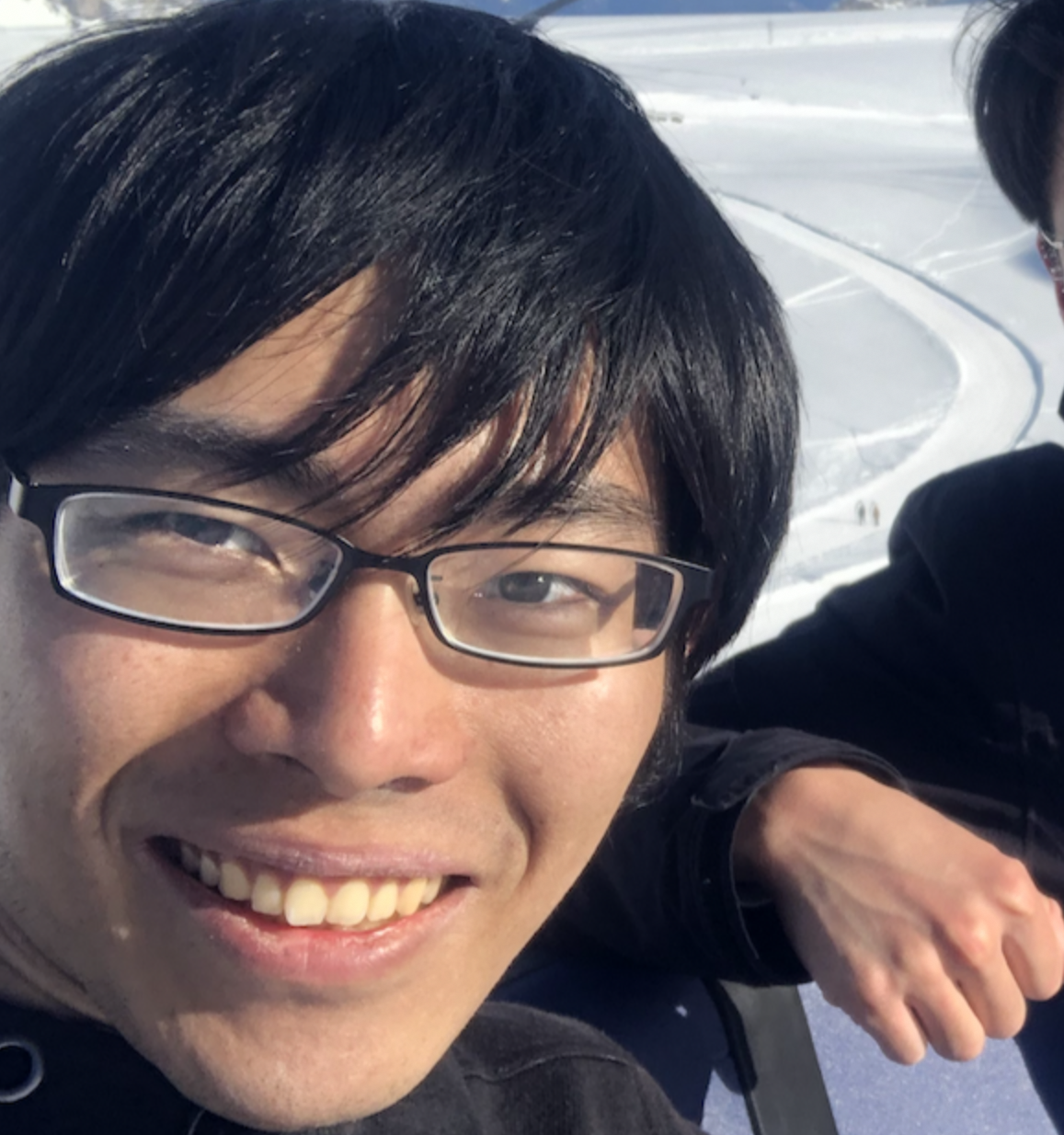
About Me
Nice to meet you. 初めまして。I'm Hiroya Umeda. 梅田滉也です。
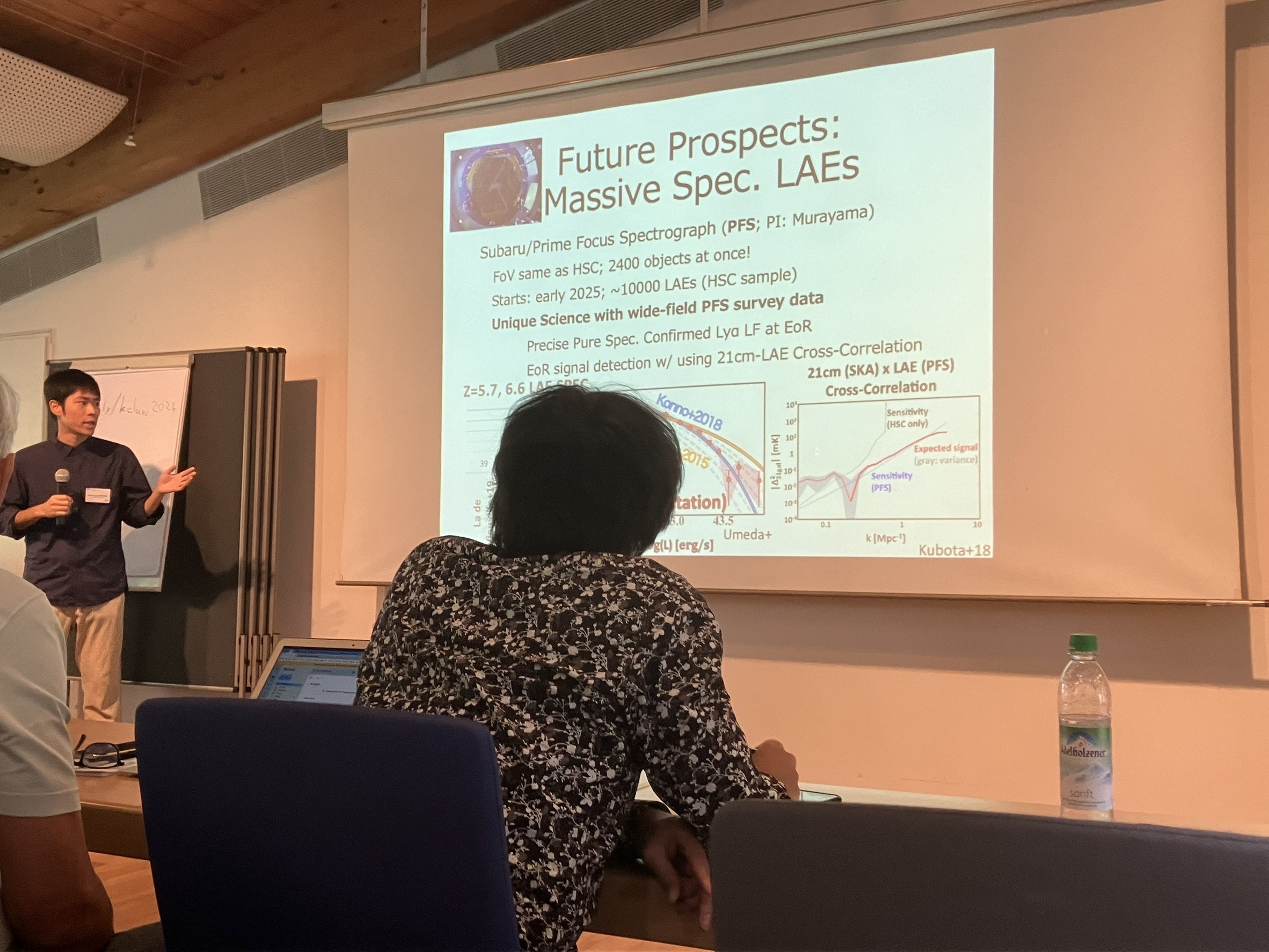
Astronomer & Ph.D.
I'm an astronomer. My main research interests are cosmic reionization and galaxy evolution. I currently work at the Center for Computational Sciences in University of Tsukuba.
- NASA/ADS: author:"Umeda, Hiroya"
- Group Website: ICRR/ObsCos Group
- Position: Researcher
I'm enjoying my life right now. How about you?
Research
I mainly work on galaxy/black hole formation and cosmic reionization. I work with optical/near-infrared data obtained with Subaru, JWST, etc...
Cosmic Reionization and Galaxy/Black Hole Formation
Cosmic reionization is the last phase change of our universe that ended around redshift 5. With the onset of the first light (i.e., stars, galaxies), ionizing photons produced by baryonic structures ionize the intergalactic neutral hydrogen gas. This cosmic scale astrophysical phenomenon thus imprints the formation of the first stars as well as the evolution of cosmic structures. My goal is to fully capture this cosmological event in the context of structure formation via observations.
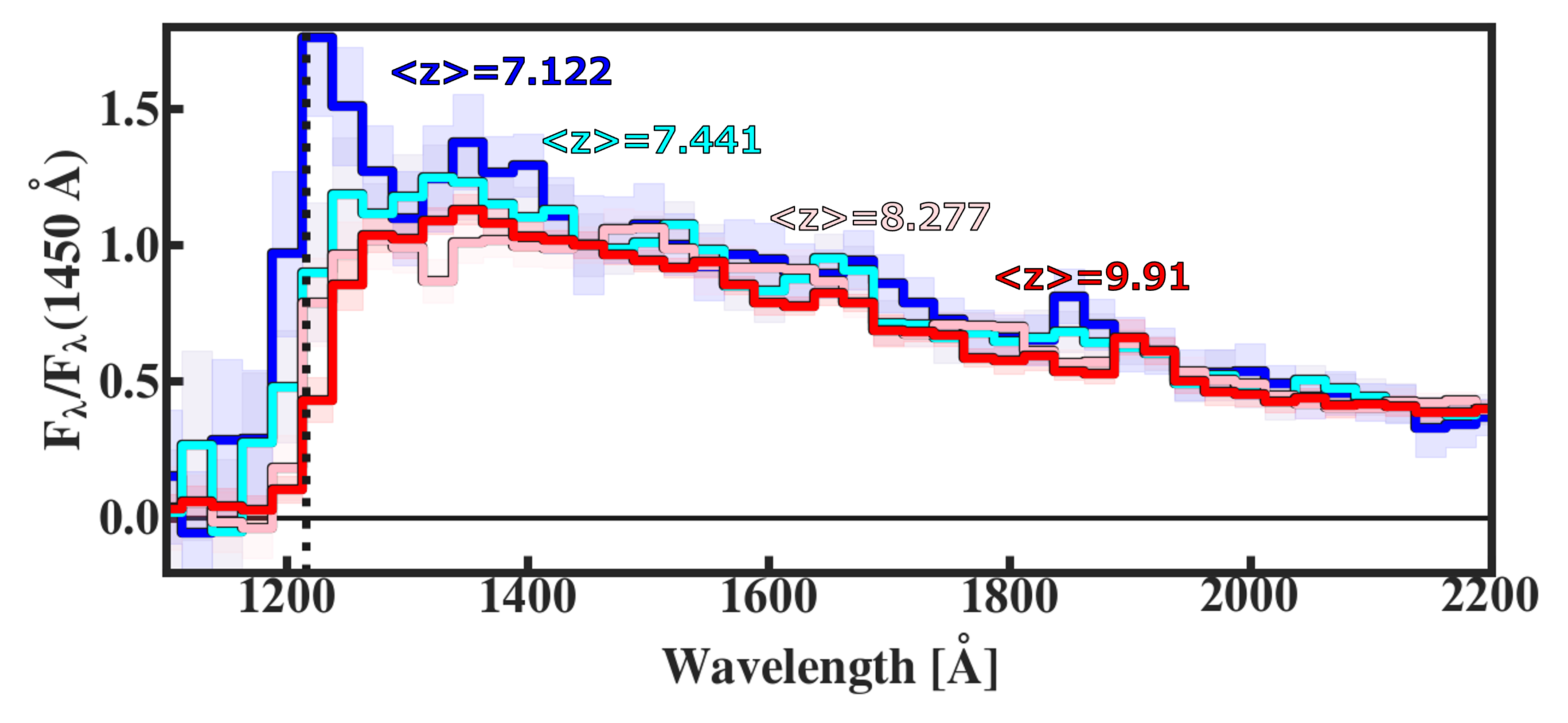
Galaxy Continuum Damping Wing Analysis with JWST
Using James Webb Space Telecope, we detect redshift evolution of galaxy spectrum shape around Lyman break. The softening of the break feature at the higher redshift suggest the increasing Lyα optical depth due to the cosmic reionization.
Statistical Study on Lyman Alpha Emitter using Subaru Telescope
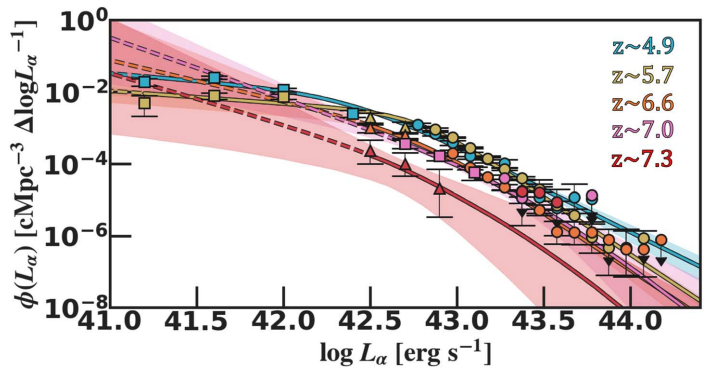
I use observations from the Subaru Telescope’s Hyper Suprime-Cam to study Lyα emitters in the high-redshift universe. By measuring their luminosity functions and angular correlation functions, I constrain their physical properties, such as typical host halo masses. At the same time, I use the attenuation of Lyα emission by neutral hydrogen in the intergalactic medium to probe the state of cosmic reionization.
Constraining Reionization History
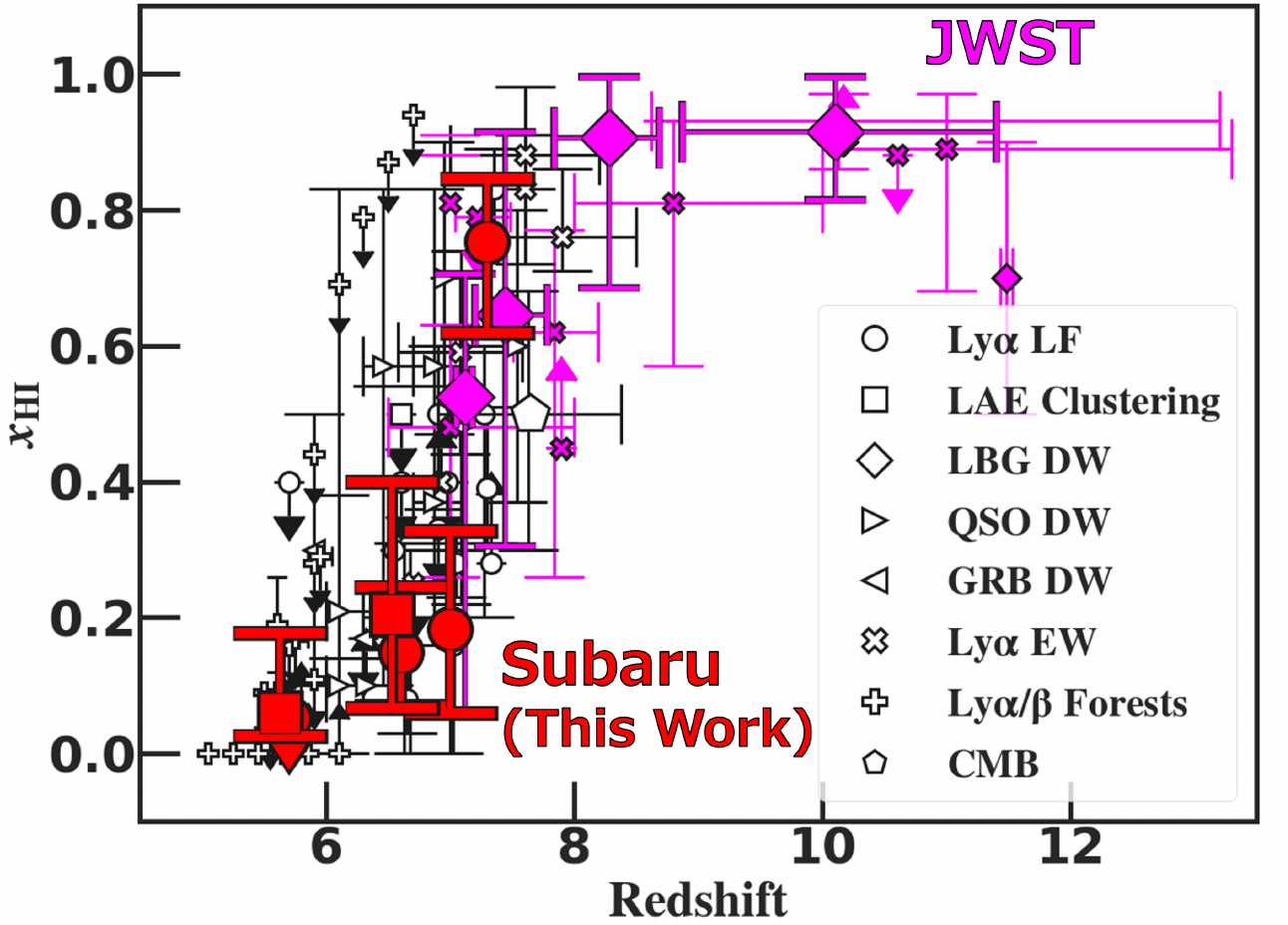
I constrain the cosmic reionization history using Lyα observations of high-redshift galaxies. By measuring the luminosity functions and clustering of Lyα emitters, I infer the neutral hydrogen fraction of the intergalactic medium. I find that reionization proceeds rapidly around z∼7, indicating a late and accelerated transition that cannot be easily explained by standard galaxy-driven scenarios alone.
Cosmological Demographics of Little Red Dots
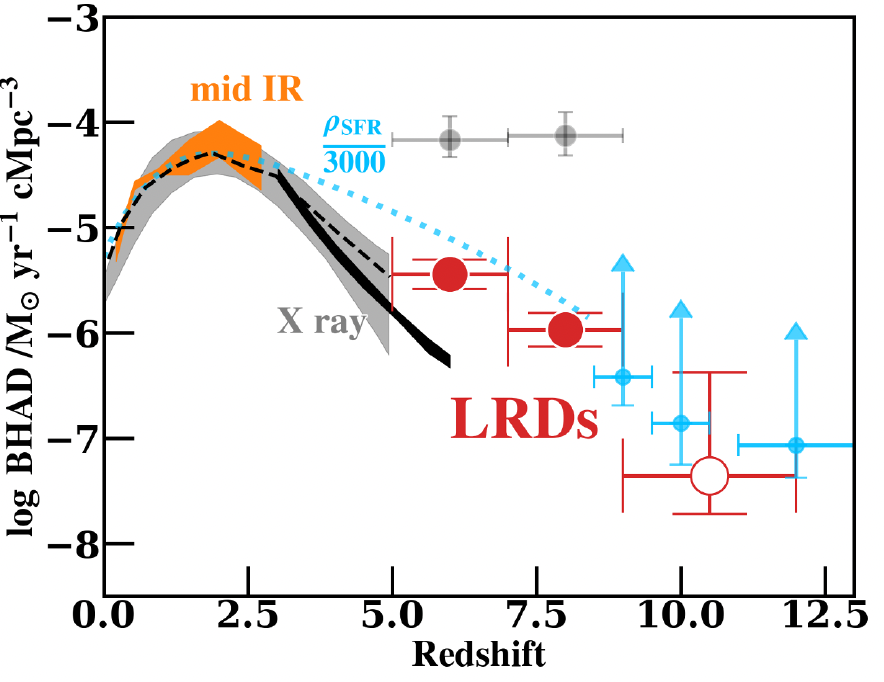
I study the demographics of Little Red Dots identified in JWST surveys to probe early black hole formation and accretion. By modeling their spectra with a black hole envelope scenario, I show that their emission is well described by blackbody radiation, leading to bolometric luminosities that are 1–2 orders of magnitude lower than previously inferred. With this revision, I find that their luminosity function, black hole mass function, and accretion rate density become consistent with those of known AGN populations, suggesting that Little Red Dots trace a key phase of rapid black hole growth in the early universe.
Origin of High-Ionization Lines in Extremely Metal-Poor Galaxies
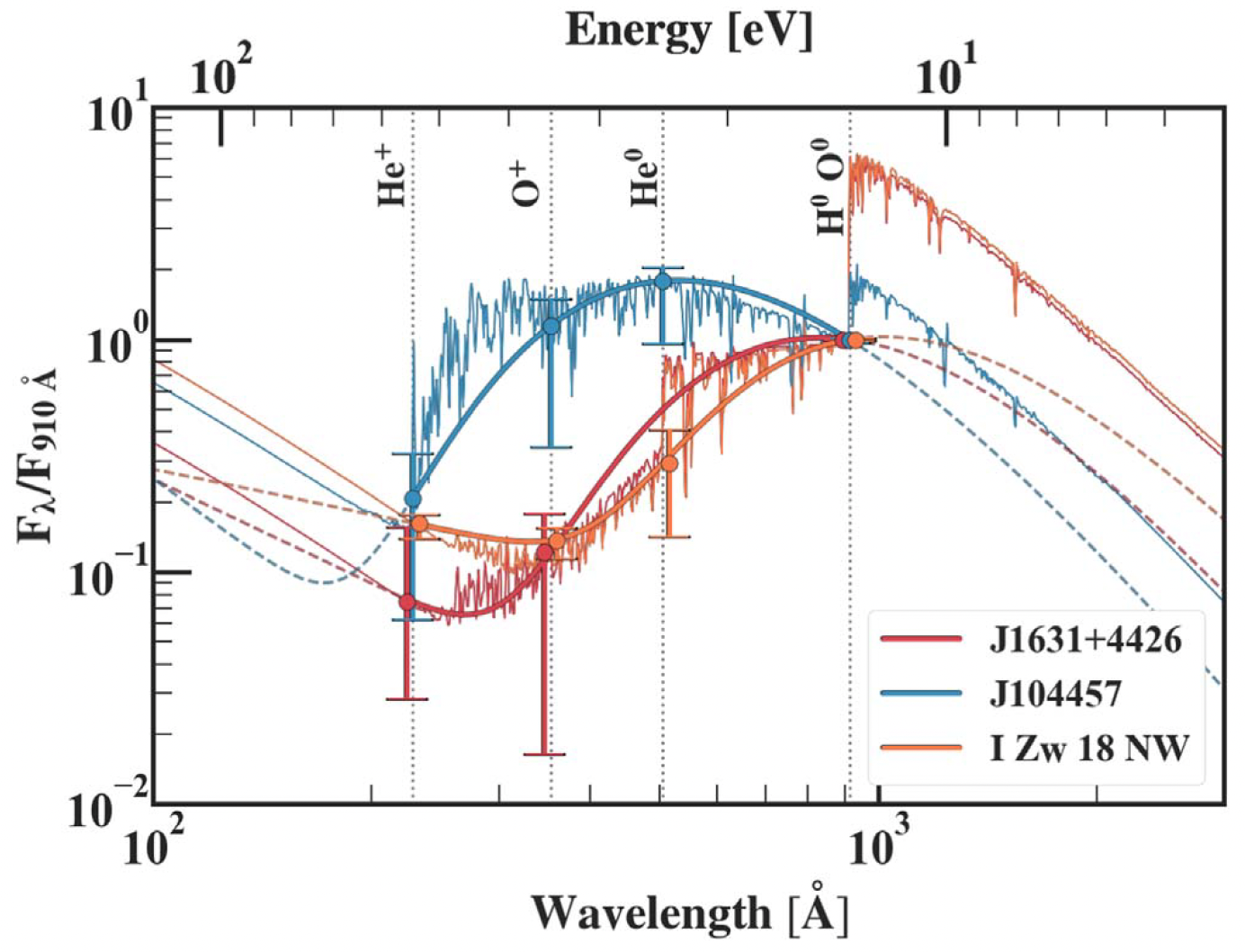
Using photoionization modeling, I reconstruct the ionizing spectra of extremely metal-poor galaxies and show that a single self-consistent spectrum can explain strong He II and other emission lines simultaneously. These spectra exhibit two distinct shapes that cannot be explained by stellar models alone, but are naturally reproduced by a combination of stars and X-ray sources, indicating a diversity of ionizing sources and a negligible role of hard photons in cosmic reionization.
CV
Academic Positions
2026
University of Tsukuba, CSS, Ibaraki, Japan
Advisor: Prof. H. Yajima
Postdoctoral Researcher
Education
Ph.D. Course
2023 - 2026
the University of Tokyo, Tokyo, Japan
Advisor: Prof. M. Ouchi
Thesis: "Statistical Study on Cosmic Reionization with Subaru/HSC Imaging and JWST/NIRSpec Spectroscopic Data" (The University of Tokyo School of Science Research Award)
Master of Science
2021 - 2023
the University of Tokyo, Tokyo, Japan
Advisor: Prof. M. Ouchi
Thesis: "Cosmic Reionization History and Sources Probed by Optical Imaging and Spectroscopy with the Subaru Telescope"
Bachelor of Science
2017 - 2021
the University of Tokyo, Tokyo, Japan
Major: Physics
Paper
First Author
- Umeda et al., A Black Hole Envelope Interpretation for Cosmological Demographics of Little Red Dots, ApJ, 999, 183, 9, 2026b
- Umeda et al., Probing the Cosmic Reionization History with JWST: Gunn-Peterson and Lya Damping Wing Absorption at 4.5< z < 13, ApJ, 997, 86, 18, 2026a
- Umeda et al., SILVERRUSH. XIV. Lya Luminosity Functions and Angular Correlation Functions from ~20,000 Lya Emitters at z~2.2-7.3 from upto 24 deg2 HSC-SSP and CHORUS Surveys: Linking the Postreionization Epoch to the Heart of Reionization, ApJS, 277, 37, 24, 2025.
- Umeda et al., JWST Measurements of Neutral Hydrogen Fractions and Ionized Bubble Sizes at z = 7 − 12 Obtained with Lyα Damping Wing Absorptions in 27 Bright Continuum Galaxies, ApJ, 971, 124, 16, 2024.
- Umeda et al., EMPRESS. VII. Ionizing Spectrum Shapes of Extremely Metal-Poor Galaxies: Uncovering the Origins of Strong HeII and the Impact on Cosmic Reionization, ApJ, 930, 37, 14, 2022.
Co-Authored
- Hatano, Ouchi, Umeda et al., EMPRESS. XIV. Strong High Ionization Lines of Young Galaxies at z = 0 - 8; Ionizing Spectra Consistent with the Intermediate Mass Black Holes with M_BH~10^3-10^6 M_sun, 2023arXiv230502189H, ApJ, 966, 170, 14, 2024.
- Harikane, Nakajima, Ouchi, Umeda et al., Pure Spectroscopic Constraints on UV Luminosity Functions and Cosmic Star Formation History From 25 Galaxies at z = 8.61 - 13.20 Confirmed with JWST/NIRSpec, 2023arXiv230406658H
- Kikuta, Ouchi, Shibuya, Liang, Umeda et al., SILVERRUSH. XIII. A Catalog of 20,567 Lyα Emitters at z = 2 - 7 Identified in the Full-depth Data of the Subaru/HSC-SSP and CHORUS Surveys, ApJS, 268, 24, 21, 2023.
and more...
Conferences
Talks (Total 29)
- (Invited)Post C2C Workshop, Tokyo Yaesu Academic Commons, Tokyo, Japan, Apr, 2026
- (LOC/Contributed)Towards the Full Bloom of First Star, Galaxy, and Black Hole Formation Exploration: JWST + Multi-Facility Observations and Theory for Future Programs, Shinjuku L Tower, Tokyo, Japan, Apr, 2026
- (Invited)Super Distant Galaxy Workshop, Tokinosu Resort, Gotenba, Japan, Feb, 2026
- Kaba Kada: Exploring the First Billion Years of the Universe, Oaks Port Douglas Resort, Port Douglas, Australia, Sept, 2025
- (Invited)Exploring Extreme Transients: Frontiers in the Early Universe and Time-Domain Astronomy, YITP, Kyoto, Japan, Aug, 2025
- Escape of Lyman Radiation from Galactic Labyrinths, OAC, Crete, Greece, Apr, 2025
- First Galaxies: Building blocks of galaxies across, U Oxford, Oxford, U.K., Apr, 2025
- Kochel CLAW, Kochel, Germany, Sept, 2024
- First Stars VII, Flatiron Institute, New York, U.S., May, 2024
- ELT Science in Light of JWST, UCLA, Los Angeles, U.S., Dec, 2023
- Resolving the Extragalactic Universe with ALMA & JWST, U Waseda, Tokyo, Japan, Nov, 2023
- (Invited)Understanding Epoch of Reionization, Sexten Center for Astrophysics, Sesto, Italy, Mar, 2023
- SAZERAC SIPS: Early Galaxy Formation Near and Far, Online, Dec, 2021
Posters (Total 2)
- FoPM Symposium, U Tokyo, Tokyo, Japan, Feb, 2023
- The 52nd Saas-Fee Advanced Course, Le Diablerets, Switzerland, Mar, 2023
Seminars (Total 11)
- (Invited)HEA Seminar, ICRR, Kashiwa-no-ha, Japan, Nov, Oct, 2024
- Galaxies Group Discussion seminar, KICC, Cambridge, U.K., Oct, 2024
- Coffee Talk, U Edinburgh, Edinburgh, U.K., Oct, 2024
- Seminar Talk, U Heidelberg, Heidelber, Germany, Sept, 2024
- Seminar Talk, UCSC, Santa Cruz, U.S., May, 2024
Grants/Fellowships/Awards
Grant
- Yukio Hayakawa Fund Travel Grant; JPY 390,903 (2026)
- JSPS Research Grant; JPY 3,000,000 (2023-2026)
- Special Grant-in-Aid for JSPS Fellows; JPY 360,000 (2025-2026)
- ILR Travel Grant; JPY 516,431 (2024)
- SUPER-IRNET Travel Grant; JPY 920,333 (2023)
Fellowships and Awards
- The University of Tokyo School of Science Research Award (2026)
- ICRR President's Award (2026)
- JSPS PD Fellowship (Declined; 2026)
- FoPM Final Exam Excellence Award (2025)
- JSPS DC1 Fellowship (2023-2026)
- FoPM Qualification Exam Excellence Award (2025)
- FoPM Fellowship (2021-2026)
and 4 awards from the conference presentations.
Contact
Inquiries on my research are always welcome! Please let me know your name and position in the email.
Location:
2nd Floor, CCS, University of Tsukuba, 1-1-1 Tennodai, Tsukuba, Ibaraki, 305-0006, Japan
Email:
ume_at_icrr.u-tokyo.ac.jp
Call:
TBA (Internal)